
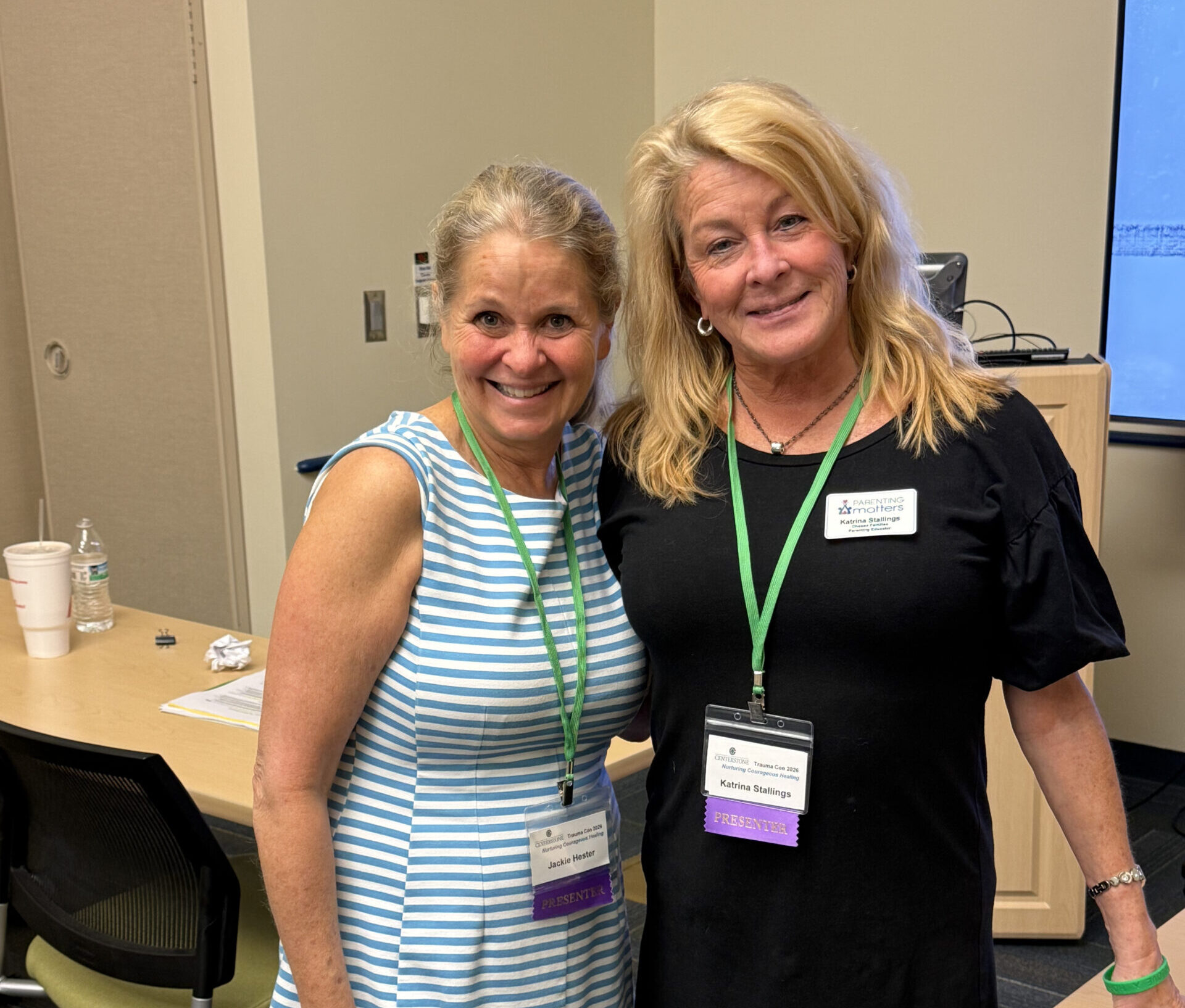
How Two Parenting Educators Are Doing Their Part to Share Knowledge with the Community
May is Mental Health Awareness Month. I know what you’re saying: “But, writer, it’s July!” I know, I know. It is important that we give this Impact Update the clout it deserves, and I don’t want it to get lost in the shuffle of other big happenings.
So, as I was saying, May is Mental Health Awareness Month, and two of our Chosen Families Parenting Educators, Jackie Hester and Katrina Stallings, presented a workshop session for this year’s Trauma Con, hosted in May to honor Mental Health Awareness Month.
The conference presented by Centerstone, now in its 3rd year, brings together hundreds of professionals working in direct service with at-risk community members. The focus is to expand knowledge and resources around being trauma-informed with as many professionals as possible. It is one thing to understand the meaning of being trauma-informed, and a whole other thing to work with children, adults, families, and communities in a trauma-informed way. Essentially, the conference helps people learn how to “Walk the Talk.”
When thinking about being trauma-informed, there are no two better individuals to help us understand this practice than Jackie and Katrina. They both have spent MANY years (I won’t say how many 😉) working with children and families through trauma challenges. They both currently serve as Parenting Educators in our Chosen Families program, both are TBRI (Trust-Based Relational Intervention®) Certified practitioners, both have advanced degrees in fields of psychology and counseling, and both have spent most of their careers working with foster and adoptive families.
In their presentation, Creating Trauma-Informed Classrooms and Educators, they dive into trauma, connections, signs to watch for, and solutions to incorporate. Trauma can develop from a number of different situations. Some of these include witnessing domestic violence, having unmet physical needs, experiencing homelessness, repeated bullying or isolation, the loss of a parent or caregiver, or having an emotionally absent parent.
When children have experienced trauma, they may respond to traditional education practices in ways that don’t seem to make sense. They might have trouble managing strong emotions, miss deadlines, display apathy or a lack of effort, act aggressively, display perfectionist tendencies, and more. And when children’s brains are stressed, they can’t learn.
The TBRI practices teach that we must start by building connection and trust with children. This can start the minute students arrive at school with the power of a hello. Research suggests that greeting students at the classroom door can strengthen their sense of connection and belonging. In one study, academic engagement increased by 20 percentage points, while disruptive behavior decreased by 9 percentage points (Terada, 2018).
And, the connection can’t stop there. Children have a need to be seen and heard. They need to know that they matter. This doesn’t mean a lack of discipline; it means that discipline doesn’t happen in the traditional sense. It is instead geared towards learning and restorative practices as opposed to punitive punishment. To be the most effective, these practices must move beyond the classroom and into the hallways, cafeterias, libraries, and yes, even the principal’s office.
Katrina shared with me one of her favorite quotes from Dr. Karyn Purvis, co-creator of the TBRI model:
“Our children need to know they are precious, in the sunshine and in the rain.”
The students of today will be the workers and citizens of tomorrow. Trauma can manifest in many ways and can lead to an increased need for Department of Children and Families involvement, higher rates of criminal justice involvement, higher mental health challenges, and greater risk for overall poor health outcomes into adulthood. And, upwards of 60% of students in school today have experienced some form of childhood trauma.
Jackie says, “Those of us who have chosen a career path dedicated to helping children, social worker or educator alike, do the very best we can do every day, limited by what we don’t know. It is with the expansion of knowledge that we do better, fully aware that better is never our final best. I believe that we have a lot more to learn, share, and collaborate on (with other providers/educators) to better understand trauma and to hopefully eliminate multigenerational trauma.”
While this brief description barely scratches the surface, one of the most powerful takeaways is that sometimes all it takes is for us [adults] to change the lens through which we view children, remembering that each of us has our own life experiences that shape our view of the world.
As an organization, Parenting Matters is committed to continued education for our team and to sharing our knowledge with the community. We know that you’re trusting us to walk alongside families in their parenting journeys, and we also know that, in order to continue doing that well, we need to stay informed about best practices. We also know that when all community organizations work together, our impact is even greater.
We hope to bring this information deeper into our school systems locally so that education teams have the tools they need to successfully support children who have experienced trauma.
Whether you’re a parent in one of our programs, a community partner, a volunteer, or a donor (or any combination of these), we are glad you’re on this journey with us.
Reference:
Terada, Y. (2018, September 11). Welcoming students with a smile. Edutopia. https://www.edutopia.org/article/welcoming-students-smile/