
Today I want to talk to you about a topic I’m passionate about: incorporating your Hispanic heritage when raising children
I am Puerto Rican and moved to this country 20 years ago. I arrived with my husband, my son (who was almost 3), and my 5-month-old daughter. Upon arrival, one of my fears was that my children would lose their identity—their connection to where they came from, including their Spanish heritage and their language.
Puerto Rican culture is a vibrant blend of three primary roots:
- the Taíno (indigenous people),
- the Spanish (European colonists), and
- West Africans (enslaved people brought to the island).
So, I dedicated myself to celebrating our heritage at home every day—consistently and intentionally—so they would learn about their roots, the Puerto Rican anthem, our traditions, and much more. And I was very clear on one thing: we would speak only Spanish at home. Of course, I’ll admit I had doubts about whether it would be difficult for them to speak English at school or understand their teachers and classmates as they grew up. So, I set out to study the benefits of raising bilingual children: the myths, the realities, and the advantages for the brain.
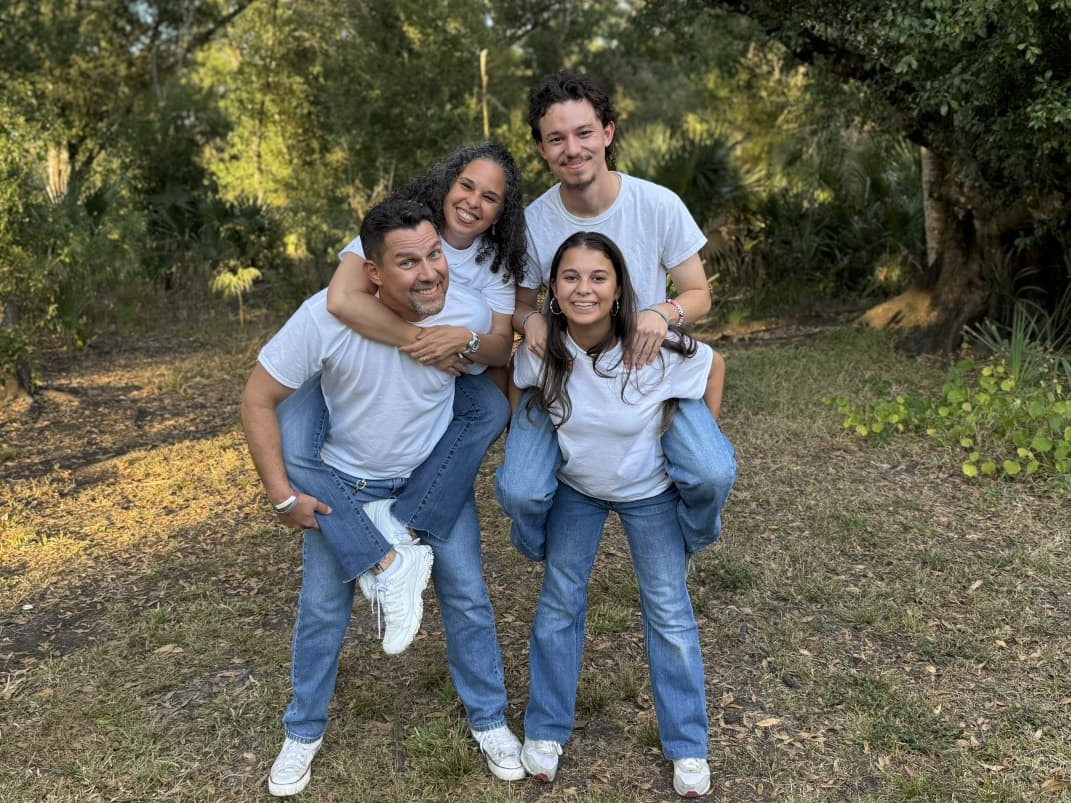
Here are some of the things I put into practice that worked for me; today, my children are 23 and 20 years old, fully bilingual, and proud of their roots. Sometimes I think they are more Puerto Rican—more “Boricua”—than I am! Hahaha. Here we go!
Simple traditions: Cook traditional recipes together (my children actually learned this from Grandma, because I don’t like cooking!).
Listen to music: Incorporate artistic elements that represent your culture for a fun, immersive experience at home.
Read traditional stories from your country to your children.
Family tree: Draw a simple family tree using photos. Share anecdotes about your grandparents or ancestors so the kids know where they come from.
Dance session: Host a party in your living room and play traditional or folk music. Teach them your favorite dance moves!
Home Cinema: Make popcorn and watch a movie or series together that highlights your culture, language, or country of origin.
Crafts: Dedicate an afternoon to making crafts that represent your culture.
All these activities helped my children love their Hispanic heritage, their culture, and their roots.
Regarding preserving Spanish, I decided that my children would speak Spanish at home—watching movies or TV and even listening to music exclusively in Spanish—whenever they were indoors.
As they grew and started VPK (pre-K), they would come home happy to explain what they had learned at school. I would get excited and say, “Very good! And in Spanish, we say…” For example, they might come home with the letter “A” and a drawing of an apple, saying, “Mommy, it’s the letter A, and it’s an apple.” I would reply, “Yes, and in Spanish, it’s the letter A and the drawing is an *manzana*; that’s how we say it in Spanish.”
I always used the phrase, “and in Spanish, it is…” to distinguish between the two languages, and this worked for me. The most important thing is to be consistent with the rules you want to establish at home for the approach to work.
As my children grew, I noticed that parents often wonder if raising bilingual children is truly worth it. The short answer, backed by decades of research, is yes. However, the benefits for bilingual children go far beyond simply knowing an additional language. Consequently, these benefits include cognitive advantages that shape how they think, learn, and interact with the world around them.
Bilingual children constantly manage two active linguistic systems. Therefore, their brains practice selecting the correct language while suppressing the other. This continuous mental exercise strengthens the neural networks responsible for executive function. Working memory allows children to retain and manipulate information in their minds.
Bilingual children learn early on that different people speak different languages. This experience fosters perspective-taking—the ability to understand that others may view the world differently. Bilingual children often develop a richer cultural identity. They can communicate with family members and also access stories, songs, and traditions in their original form. This connection strengthens family ties and builds trust.

Academic performance and long-term outcomes
Parents sometimes worry that bilingualism might delay academic progress. However, research consistently shows the opposite. After an initial adjustment period, bilingual children tend to match or outperform their monolingual peers academically.
Professional advantages in adulthood
The benefits extend into adulthood as well. Bilingual adults have access to broader job markets and often earn higher salaries. Speaking two languages gives them the opportunity to reach more people.
Debunking the “confusion” myth
One of the most persistent myths about raising bilingual children is that two languages will confuse them.
When bilingual children mix languages within a single sentence, adults sometimes interpret this as confusion. In reality, through this behavior, they are applying the grammar of both languages simultaneously.
Therefore, when a child speaks a sentence mixing Spanish and English, they are not confused. They are making a deliberate, rule-governed choice. They often code-switch because they know a particular word better in one language or because the person they are speaking to understands both languages.
Practical tips for raising bilingual children
- Maximize quality exposure
- Parents should focus on meaningful interactions in both languages. Reading aloud, storytelling, singing songs, and having real conversations count as high-quality exposure. Passive exposure via television, on the other hand, has a much weaker effect.
- Create consistent language routines.
- Many families use the “One Parent, One Language” approach. However, this is not the only effective strategy. Some families assign languages to specific contexts, such as one language at home and another at school. Others use time-based strategies, alternating languages by day of the week. The key is consistency within the chosen system.
- Reading is one of the most powerful tools for bilingual development. Books provide vocabulary, grammatical models, and cultural context all at once. Furthermore, repetition helps; children benefit from hearing the same story multiple times.
- Connect with the community. Children need to see that their second language has social value. Playing with other bilingual children, attending heritage language schools, participating in cultural events, and visiting family abroad reinforce the importance of both languages. When children see others using their second language, they become more motivated to use it themselves.
- Be patient with the process.
- Bilingual development does not follow a perfectly linear path. Children may go through periods where they prefer one language over the other. This is normal. Continuous exposure and positive parental attitudes are the strongest predictors of long-term bilingual success.